Two Keys to Deep (& Safe) Hip Opening
The muscles of our outer hips are really big and strong. That also means tight. Tight hips pull on the low back and often force our knees and ankles to compensate, which can lead to knee pain and problems like bunions in the feet. Needless to say, opening the hips creates a lot of freedom, and gives us access to fun poses like Flying Pigeon and Foot Behind the Head.
The Keys
It is both action as well as alignment that are the two keys to deep and safe hip opening.
The keys to safely stretching our outer hips lie in our legs, specifically in how we engage our feet and knees. The trick — and this is true for any part of the body — is to tone and support the looser or smaller areas so the bigger, tighter ones have to open instead. This is how we loosen what is stiff, tight and stuck, while strengthening what is smaller or weaker.
Action
Muscular energy is essentially a blanket of support. In the lower legs it’s what protects our knees and feet from pain and injury when we open our hips.
On a gross level, we create it by literally engaging our muscles. Instructions such as “Lift and spread your toes,” and “Squeeze your legs towards each other as if to wrinkle up your sticky mat” are to engage strong muscular energy.
A more subtle level is found simply through our imaginations. This is the “Hug your skin and muscles to your bones” kind of instruction. Your skin and muscles will tone when you flex, the trick is to keep the tone while you stretch. This is much more difficult and where imagination will help.
Try it:
- Stand in Tadasana or take Down Dog.
- Slightly bend your knees (this makes it easier).
- Press down at the inner balls of your feet and hug your outer ankles in towards your midline.
- Spread your toes, especially the fourth and fifth ones.
- Make sure your knees and feet are parallel, don’t let your heels drop in.
Alignment
Hip opening invariably involves rotation in the femur (thigh bone). Rotation is how we stretch all those deep outer hip muscles that work when we stand, squat, walk, run, hike or climb stairs. When the hip is tight, rotation is limited. The flimsier areas of the leg, namely the knee and foot, try to take the rotation instead. This torque is not only dangerous but also painful.
To save our joints and get at those hip muscles, we need to find “true” alignment and keep it while we bend, rotate and move our legs around. The safest way to start is sitting. Later, move to weight bearing exercises like Pigeon.
Try it:
- Sit on the ground and stretch a leg out in front of you.
- Spread your toes and activate muscular energy in your leg, same as you did above.
- Make four imaginary dots on your leg: base of your second toe, center of your ankle, center of your knee and center of your thigh bone where it meets your groin.
- These four dots in a straight line make your leg alignment “true.”
- Keep all four dots in a line as you bend and straighten your leg a few times.
- Now, keep your knee bent, heel on the ground and rotate in the hip socket to turn your whole leg in and out a few times with dots aligned.
- It should feel like you’re moving your leg as one piece and rotating in the hip socket.
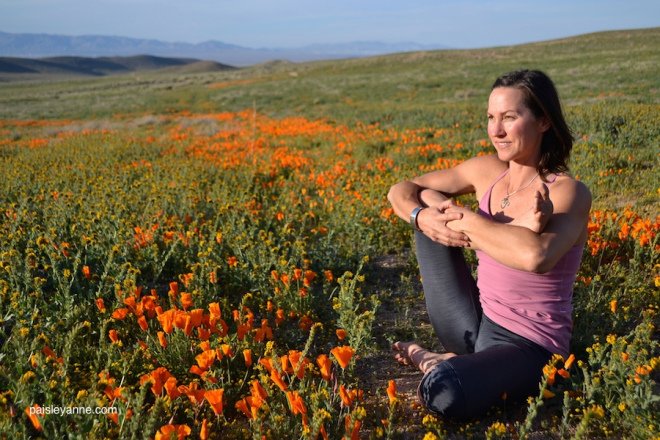
- If all that went well, then go deeper by applying these techniques to Baby Cradle (pictured here). Caution: Make sure you don’t use your hands to yank on your foot; keep the ankle and knee strong and steady as you rotate in the hip socket.


Thank you for an informative and timely post! As an avid cyclist, and someone who stands at work all day long - When I practice, my hips are always needing a little extra time to sort out. :)